Why Creatine Is the Only Supplement We Universally Recommend
In a supplement industry full of questionable claims, creatine monohydrate stands alone as the most thoroughly researched, universally effective performance supplement available. Over 500 peer-reviewed studies support its benefits for strength, power output, muscle recovery, and even cognitive function. It's produced naturally in your body, found in meat and fish, and supplementing with 5g daily raises muscle stores to optimal levels safely.
Every other supplement we've looked at has caveats, contraindications, or questionable evidence. Creatine is the exception. The International Society of Sports Nutrition calls it "the most effective ergogenic nutritional supplement currently available." At $0.30 per serving, it's also the cheapest.
Our Pick
Nutricost Creatine Monohydrate
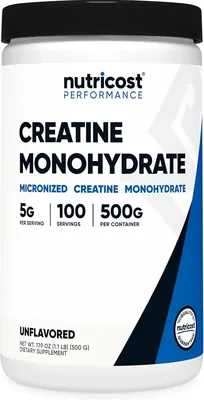
100 servings, third-party tested, $0.30/serving. The most studied form of creatine.
How to Take Creatine
Loading phase (optional): 20g per day (split into 4 doses) for 5-7 days. This saturates muscle stores quickly. Not required — it just gets you to full stores faster.
Maintenance dose: 3-5g per day, every day. Timing doesn't matter much — consistency matters. Take it whenever you'll remember to take it daily.
With what: Mix with water, juice, or your protein shake. The micronized form dissolves better than regular powder. Taking it with a carbohydrate source may slightly improve uptake.
How long to see results: Muscular creatine stores reach saturation in 2-4 weeks (or 1 week with loading). Strength and performance improvements are typically noticeable within 2-4 weeks of full saturation.
Common Concerns Addressed
"Does creatine cause water retention?" Yes, slightly — creatine draws water into muscle cells, which increases total body water by 1-3 lbs. This is intracellular water (inside muscle cells), not subcutaneous bloating. Your muscles actually look slightly fuller.
"Is creatine safe long-term?" Studies spanning 5+ years show no adverse effects in healthy adults. It's one of the most safety-studied supplements in existence.
"Does creatine cause hair loss?" One study from 2009 showed elevated DHT levels, but this hasn't been replicated in subsequent research. The current scientific consensus does not support a causal link between creatine and hair loss.
💊 Creatine Buyer Guide: Cutting Through the Marketing
Creatine monohydrate only. Don't let supplement brands charge you 3x more for "Kre-Alkalyn," "HCl," or "buffered" creatine. Meta-analyses consistently show creatine monohydrate equals or outperforms every fancy variant. The fancier forms were created to justify higher prices, not improve outcomes. Buy the cheapest per-gram monohydrate you can find from a reputable brand.
Third-party testing matters. Look for NSF Certified for Sport, Informed Sport, or Labdoor tested creatine. These certifications verify that what's on the label is what's in the tub — important for competition athletes and anyone who cares about putting what they think they're putting in their body.
Micronized vs. standard. Micronized creatine has smaller particles that dissolve more easily in water and may reduce the stomach discomfort some people experience with standard monohydrate. If you've had GI issues with creatine before, try micronized before switching to an alternative form.
Bottom Line
Creatine monohydrate is the single most evidence-backed supplement for athletic performance. Nutricost delivers 100 servings of third-party tested, pure monohydrate for $30 ($0.30/day). There's no reason to buy expensive "designer" creatine forms — monohydrate is the most studied and most effective form, period.