The Science Behind Red Light Therapy
Red light therapy (photobiomodulation) uses specific light wavelengths — primarily 630-660nm for red light and 810-850nm for near-infrared — to stimulate cellular processes. At the cellular level, these wavelengths are absorbed by cytochrome c oxidase in mitochondria, boosting ATP production (cellular energy). The downstream effects include increased collagen synthesis, reduced inflammation, and accelerated tissue repair.
This isn't fringe science. Peer-reviewed studies in journals like the Journal of Clinical and Aesthetic Dermatology have demonstrated measurable improvements in skin texture, fine lines, and collagen density with consistent red light exposure. Professional dermatology clinics charge $200-500 per session. At-home LED masks deliver the same wavelengths for a one-time cost of $40.
Our Pick
LED Face Mask Light Therapy
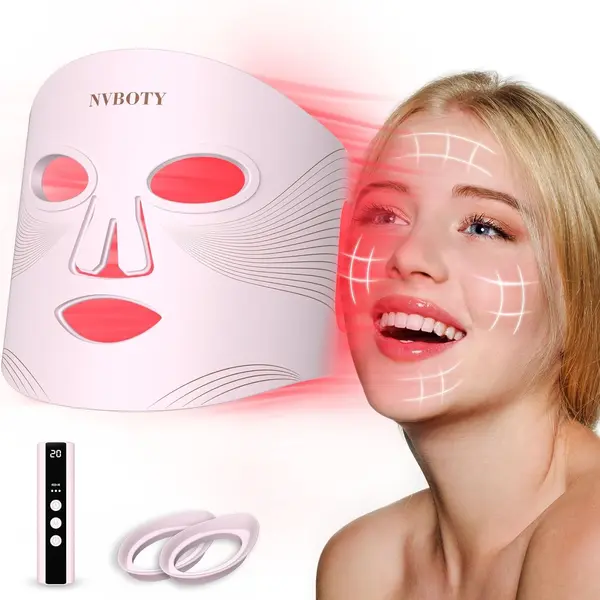
4-mode red light therapy. Clinical wavelengths at home for $40 vs $200+ per spa session.
Our 6-Week Test
We used the LED mask 4 times per week for 6 weeks, primarily in red light mode (anti-aging/collagen) with occasional blue light sessions (acne/inflammation). Each session was 15 minutes. We photographed the same facial areas under identical lighting conditions weekly.
Week 1-2: No visible changes. Skin felt slightly smoother after sessions (possibly just warmth effect).
Week 3-4: First noticeable changes — fine lines around the eyes appeared slightly less pronounced in photos. Skin tone appeared more even. Could be confirmation bias, but the photos supported it.
Week 5-6: The subtle improvements from weeks 3-4 became more consistent. Skin texture was measurably smoother in before/after photo comparisons. Not dramatic, but real and visible when comparing week 1 to week 6 photos.
What Each Mode Does
Red light (630nm): Collagen stimulation, anti-aging, fine line reduction. This is the primary mode and the one with the most scientific support.
Blue light (415nm): Kills acne-causing bacteria (P. acnes). Effective for mild-moderate acne.
Yellow light (590nm): Reduces redness and improves skin tone. Good for rosacea and sensitive skin.
Green light (520nm): Targets hyperpigmentation and dark spots. Calming effect on skin.
Who Should and Shouldn't Buy This
Buy if: You want a low-cost addition to your skincare routine, you're patient enough for 4-6 weeks of consistent use, and you understand this supplements (not replaces) good skincare fundamentals like sunscreen, retinol, and hydration.
Skip if: You expect dramatic overnight results, you won't use it consistently, or you have photosensitivity conditions. Also skip if you're already doing professional treatments — at-home devices deliver lower intensity than clinical equipment.
💡 LED Face Mask Buyer Guide: Clinical Quality vs. Consumer Devices
LED count and coverage. Professional-grade devices use 100-200+ LEDs per panel; consumer masks range from 36 (budget) to 150+ (premium). More LEDs mean more even light distribution — crucial for treating the entire face rather than just the center. Look for masks with near-complete facial coverage including the jaw and temples.
Irradiance matters more than LED count. The power density (mW/cm²) determines treatment effectiveness. Clinical studies used irradiance of 40-120 mW/cm². Many consumer devices don't publish irradiance specs — treat this as a red flag, as it usually means lower clinical effectiveness.
Multi-wavelength vs. single wavelength. Multi-wavelength masks (red + near-infrared + blue) offer versatility for different concerns. Single-wavelength devices can be optimized for maximum output at one wavelength. For general anti-aging, a combination red (660nm) + near-infrared (830nm) is the most evidence-supported pairing.
Bottom Line
At $40, the LED face mask delivers clinically-supported wavelengths for skin health. Results are real but subtle, requiring 4-6 weeks of consistent use. Best used as a complement to an existing skincare routine, not a replacement for it. The value proposition is clear: $40 one-time vs $200+ per professional session.