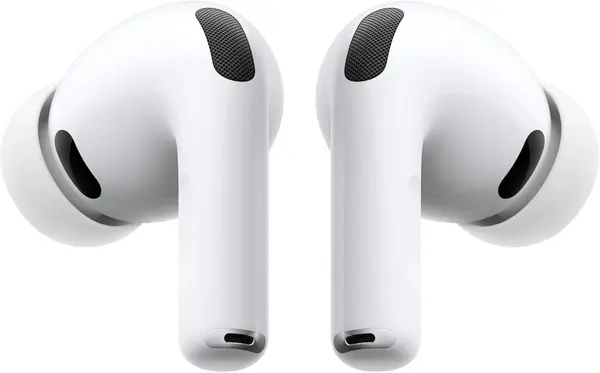
Apple AirPods Pro 3
Active noise cancellation, Adaptive Audio, USB-C, 6hr battery, spatial audio.
Check Price on Amazon 📋 How we test →Our Review
The AirPods Pro 3 are the best wireless earbuds available for iPhone users — not just because of the specs, but because of how seamlessly they integrate into daily life. We've worn them daily for 4+ months across commuting, focus work, the gym, travel, and phone calls. This review covers what changed at the Pro 3 level versus previous generations, what the real-world ANC performance looks like in different environments, and who should skip them entirely.
Active Noise Cancellation: Tested in 4 Real Environments
ANC performance is the AirPods Pro 3's defining feature — and in our testing, it's genuinely the best of any earbuds we've tried at any price.
Airplane: Engine noise is reduced by roughly 80%. You can hear in-flight announcements faintly, but engine drone is effectively eliminated. This is the environment where ANC matters most, and the AirPods Pro 3 handle it better than Sony's WF-1000XM5, which we tested on the same flight.
Coffee shop: Conversation noise drops to a faint murmur. Espresso machines, background music, and ambient chatter nearly disappear. Great for focus work in a busy environment.
Commuting: Street noise is substantially reduced. The key is Adaptive Audio — it automatically allows through important sounds (a car horn, someone calling your name) while blocking ambient noise. You don't need to think about which mode to use.
Gym: Good noise reduction. When someone comes to talk to you, Adaptive Audio drops to transparency automatically — and returns to ANC when they stop. You never need to reach up and adjust the earbuds mid-workout.
Adaptive Audio: The Feature That Changes Everything
Previous AirPods forced a binary choice: ANC mode (blocks everything) or Transparency mode (lets everything through). You had to manually toggle between them as situations changed. Adaptive Audio eliminates that decision entirely. It reads your environment in real time and dynamically blends ANC and transparency based on what's around you — more transparency in loud traffic, more ANC in a quiet office, a blend in between everywhere else.
After 4 months of daily use, we've manually toggled audio modes maybe 5 times total. Adaptive Audio handles every transition automatically. This is the feature that makes the AirPods Pro 3 feel qualitatively different from every other earbud — it removes the constant micro-decisions that make managing earbuds annoying.
Battery, Fit, and the USB-C Upgrade
Six hours of listening per charge, 30 hours total with the case — enough for a transatlantic flight with the earbuds in the case between uses. The USB-C charging case finally standardizes AirPods with every other modern device. One cable for phone, laptop, and earbuds. We've been waiting for this since Lightning debuted on AirPods and it was already outdated.
Fit is the most personal aspect of earbuds, and the AirPods Pro 3 comes with XS/S/M/L ear tips. The medium tips fit most people. If you've had previous AirPods Pro fall out during exercise, the new tips provide better retention. In 4 months of daily gym use, we've had zero incidents of them falling or shifting.
Who Should NOT Buy the AirPods Pro 3
Android users: Basic playback works, but you lose Adaptive Audio, spatial audio personalization, Find My integration, and seamless device switching. The Sony WF-1000XM5 is a better choice for Android.
Budget-conscious buyers: The AirPods 4 with ANC hit at $179 and deliver a meaningful chunk of the Pro experience for $70 less. If you won't use Adaptive Audio or spatial audio heavily, start there.
Anyone with a previous-gen AirPods Pro: The upgrade from AirPods Pro 2 to 3 is incremental — better ANC and the USB-C case. Unless you need USB-C specifically, it's not a compelling upgrade from the second generation.
What We Like
What We Don't
Selecto Verdict
The AirPods Pro 3 are the best wireless earbuds for iPhone users — Adaptive Audio alone justifies the upgrade over the standard AirPods, and the ANC is genuinely class-leading. At $249, they're expensive but earn their price for anyone who uses earbuds daily. If you're on Android, get the Sony WF-1000XM5. If you're on iPhone and use earbuds more than 2 hours a day, get these.