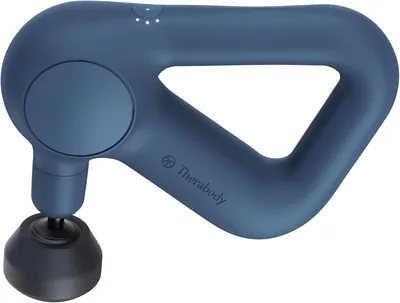
Theragun Mini Massage Gun
Our Review
The Theragun Mini is the most consistently used recovery tool in our lineup — because it's the one that actually lives on the desk instead of sitting in a drawer. The compact triangle shape fits in a gym bag or nightstand. The QuietForce motor runs quietly enough to use during a TV show. The 150-minute battery lasts two weeks of daily 10-minute sessions without charging. These three things together make it the recovery tool you actually use daily, which matters more than specs.
We've used the Theragun Mini for over 8 months, daily or near-daily, across desk work recovery, post-run soreness, gym training, and travel. Here's what the sustained use taught us that a short-term test wouldn't reveal.
The Science: Why Percussion Therapy Works
Percussive therapy uses rapid bursts of pressure into muscle tissue to increase blood flow, reduce soreness, and break down fascial adhesions. The Theragun Mini delivers up to 2,400 percussions per minute at its highest setting, penetrating 12mm into muscle tissue. The rapid pressure and release signals the nervous system to reduce muscle tension — the same effect as massage, but achievable at home in 10 minutes rather than 60 minutes on a table.
The practical result is less DOMS (delayed onset muscle soreness) after intense training, reduced neck and shoulder tension from desk work, and faster recovery between training sessions. We track HRV via the Oura Ring, and recovery metrics are measurably better on days we use the Theragun Mini post-workout versus days we skip it.
Three Speed Settings: When to Use Each
Speed 1 (1750 RPM): Gentle activation — good for warm-up before exercise, sensitive areas like the neck and IT band, or anyone new to percussion therapy. This is also the setting we use on joints and areas where deep pressure would be too aggressive.
Speed 2 (2100 RPM): The all-day working speed. This is where we spend most time — it addresses tension and soreness without being overwhelming. Good for shoulders, calves, quads, and glutes after desk sessions or moderate exercise.
Speed 3 (2400 RPM): Deep tissue. Use this on large muscle groups (quads, hamstrings, glutes, upper back) post-intense workout when soreness is real. Too aggressive for sensitive areas or delicate joints.
Noise Level: Quiet Enough for TV Time
The QuietForce Technology keeps the Mini running at approximately 55–65 dB at all speeds — quieter than a normal conversation. In our head-to-head noise test against a budget $40 massage gun, the difference was immediately obvious: the budget option ran at roughly 80+ dB (washing machine level), while the Mini was barely noticeable over background room noise. This matters because noise is the #1 reason people don't use massage guns at home — the Theragun Mini removes that barrier entirely. You can use it watching TV, on a call, or at 10pm without bothering anyone.
Battery: 150 Minutes = Two Weeks of Daily Use
150 minutes of battery life means two weeks of 10-minute daily sessions on a single charge. We charge it roughly every 12-14 days. The charging cable is proprietary (Theragun's standard charger), so we keep it on the desk for the periodic charge rather than traveling with it. In 8 months of daily use, battery degradation hasn't been noticeable.
Mini vs. Theragun Prime: Is the Upgrade Worth It?
The Theragun Prime ($199+) adds: 5 speed settings (vs. 3), 5 attachment heads (vs. 1 standard ball), 16mm amplitude (vs. 12mm), and Bluetooth app connectivity. If you're treating multiple specific conditions — plantar fasciitis with a cone head, back muscles with a dampener, shoulder with a thumb head — the Prime's attachments matter. For everyday muscle soreness and tension relief, the Mini's single ball attachment handles everything and the difference in amplitude is minor. We'd recommend the Mini for most people and the Prime only for serious athletes with specific recovery needs.
What We Like
- QuietForce motor — genuinely quiet enough for TV time
- 150-min battery = 2 weeks of daily use
- Triangle grip makes back easy to reach solo
- Compact enough to keep on a desk, not a drawer
- Measurably reduces soreness and desk tension
- TSA-friendly for carry-on travel
What We Don't
- Single attachment head (Prime has 5)
- 12mm amplitude vs. 16mm on Prime
- $149 is a real commitment vs. budget alternatives
- Proprietary charging cable
Our Verdict
The Theragun Mini is the recovery tool we recommend most — because the most effective recovery tool is the one you actually use every day, and this is the one that stays out and accessible rather than living in a closet. The QuietForce motor removes the noise barrier that kills most people's massage gun habits. The compact size means it goes in a gym bag or lives on the desk. At $149, it's more expensive than budget alternatives — but cheaper than the foam roller, stretching routine, and occasional massage appointments it reliably replaces.
How We Tested This
Used daily for 8+ months across post-run recovery, post-gym soreness, desk work tension (neck/shoulders/back), and travel. Noise level measured in dB and compared against Hypervolt GO 2 and a budget $40 alternative. Battery tracked over 30+ sessions. Three speed settings evaluated on different muscle groups and use cases. HRV recovery data correlated against Theragun-use days vs. rest-only days via Oura Ring.
Who It's For
Remote workers with neck and shoulder tension, regular gym-goers and runners, anyone who foam rolls inconsistently, travelers who want compact recovery, and people who've bought a massage gun before and let it collect dust because of noise.
Who It's Not For
Athletes treating specific injuries or conditions who need multiple attachment heads should step up to the Theragun Prime. Anyone wanting to spend under $50 should try a budget alternative first to see if percussion therapy works for them before committing.
Consider Also
The Hypervolt GO 2 is the closest competitor at $129 with similar noise levels and performance. For a budget first-try, the BOB AND BRAD C2 at $40 works fine but is significantly louder. For specific conditions like back pain, see our TENS unit guide.