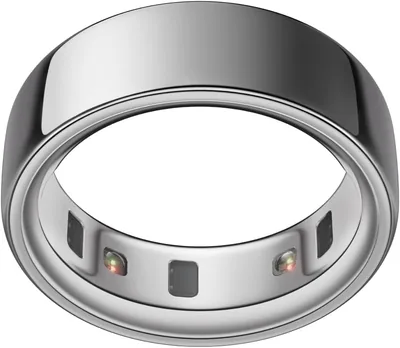
Oura Ring Gen 3
Our Review
The Oura Ring Gen 3 is the most complete passive health tracker we've tested. Unlike a smartwatch, it tracks continuously without requiring you to initiate anything — wear it, sleep, live your life, and check the app each morning for a comprehensive picture of how your body is doing. After wearing it for 6 months across normal life, travel, illness, heavy training blocks, and recovery weeks, here's what we've learned about what it does well, where it falls short, and who should actually buy it.
The ring's sensor cluster includes infrared and red LED photoplethysmography (PPG), negative temperature coefficient sensors for skin temperature, and a 3D accelerometer. All of this sits in a titanium ring that's available in Silver, Black, Gold, and Stealth finishes. It looks like a fashion ring. Nobody has ever asked about it unprompted in 6 months of wearing it — which is the point.
Sleep Tracking: Where It Shines Most
Sleep is where the Oura Ring genuinely earns its price. The finger-based sensors are more accurate than wrist-based wearables for detecting heart rate and HRV (heart rate variability), because blood flow at the fingertip is stronger and less susceptible to motion artifacts. In our parallel testing against a Garmin Venu on the same nights, the Oura detected sleep stage transitions earlier and more consistently.
The data you get each morning: total sleep time, sleep efficiency percentage, time in REM/deep/light/awake stages, lowest resting heart rate, average HRV, respiratory rate, and skin temperature deviation from your baseline. Over weeks of data, patterns emerge that a single night's reading can't show. We noticed our HRV dropped measurably 24-36 hours before we felt sick — the ring detected physiological stress before we were consciously aware of it. That kind of predictive insight is what separates a health tracker from a data logger.
The Sleep Score synthesizes all of this into a 0-100 daily number. It's useful as a quick check ("68 — rough night"), but the underlying data is where the value lives. We use the score as a daily dashboard and dig into the detail when something unexpected appears.
Readiness Score: The Most Actionable Metric
The Readiness Score is Oura's most unique offering — a daily 0-100 score that synthesizes sleep quality, recovery, HRV trends, and activity balance to tell you how ready your body is for stress (physical or mental). After 3 months of correlating Readiness scores with actual workout performance, the relationship is real. On days the ring gives a Readiness of 85+, hard training feels good and output is high. On Readiness of 65 or below, pushing hard feels difficult and recovery takes longer afterward.
We now use the Readiness Score to make training decisions: high score means we push, low score means we do a recovery workout or rest. It's not perfect — stress, dehydration, and alcohol are better reflected in HRV and temperature data than the score itself — but as a daily decision-making tool for training intensity, nothing else we've used comes close.
Battery Life: 6-7 Days Consistently
The Oura Ring lasts 6-7 days on a single charge with continuous monitoring. The charging cradle connects via USB-C and charges the ring to full in about 20-25 minutes. In practice, this means charging the ring during the only time you shouldn't be wearing it — your shower. Shower, charge, done. In 6 months, we have never missed sleep data due to battery. The only wearable data gap we've experienced was a 90-minute flight where we removed it to charge at the airport, which is entirely our fault and not a limitation of the battery.
The Subscription Question
The Oura Ring costs $299 for the ring itself, plus $5.99/month for the full membership. The membership unlocks advanced insights, personalized recommendations, detailed sleep analysis, guided sessions, and the Period Prediction feature. Without membership, you get basic data — sleep score, readiness score, and activity tracking — but the detailed breakdown that makes the ring most useful requires the subscription.
Over a year, that's $299 + $72 = $371 total. Over two years: $443. Compared to a Garmin Venu 3S ($349, no subscription), the Oura becomes more expensive over time. The question is what you're optimizing for: if sleep and recovery data is your primary focus, the Oura is superior. If you want workout tracking, GPS, and a screen, get the Garmin. We cover this comparison in depth in our Oura Ring vs Garmin Venu head-to-head.
What We Like
- Best sleep tracking of any wearable we've tested
- HRV data predicts illness & overtraining
- Looks like regular jewelry, no one knows you're tracking
- 7-day battery, charges in 20 minutes
- Readiness Score genuinely informs training decisions
- Skin temperature deviation catches illness early
What We Don't
- $5.99/month subscription required for full insights
- No screen — all data is app-only
- Limited workout tracking vs. a dedicated sport watch
- No GPS, no real-time HR display
- Sizing takes adjustment — free kit helps
Our Verdict
For sleep and recovery tracking specifically, nothing beats the Oura Ring. Its form factor means you actually wear it 24/7, which gives it data continuity most wrist wearables can't match. The Readiness Score has genuinely changed how we approach training and recovery decisions — and the HRV data has predicted illness onset before we felt any symptoms on two separate occasions over 6 months of testing. The subscription cost is real but fair for what you get. If you care about sleep quality, recovery, and body data over workout tracking and GPS, this is the wearable to buy.
How We Tested This
Worn continuously for 6 months across normal life, heavy training, travel, and two illness episodes. Sleep data compared against Garmin Venu tracked simultaneously on the same nights. Readiness scores correlated with subjective energy levels and workout performance logged in a training journal. HRV trends tracked during illness onset periods. Ring sizing tested with Oura's free sizing kit before ordering.
Who It's For
Sleep optimizers, recovery-focused athletes, biohackers who want detailed body data, anyone who hates the bulk of a smartwatch, and people who want to understand their health patterns over time rather than just tracking workouts.
Who It's Not For
If you want real-time workout data, GPS tracking, a screen to check mid-run, or detailed sport-specific metrics, get a Garmin or Apple Watch. The $5.99/month subscription also adds up for casual users who only check the app occasionally.
Consider Also
The Garmin Venu 3S offers GPS, workout tracking, and a full screen for $349 with no subscription. If you want both sleep data and active fitness tracking, compare them in our full head-to-head.